Home · The five
The signature desk
Which of the five?
Five wrecks in the hall, five jobs on the water, and a sixth number that turned out to belong to the great longship. Choose a ship on the desk. Official figures stay unblended.
The signature desk
Which of the five?
Six official stories, kept separate: five wrecks in the hall, and the number that was never a sixth ship.
The ocean-going trader
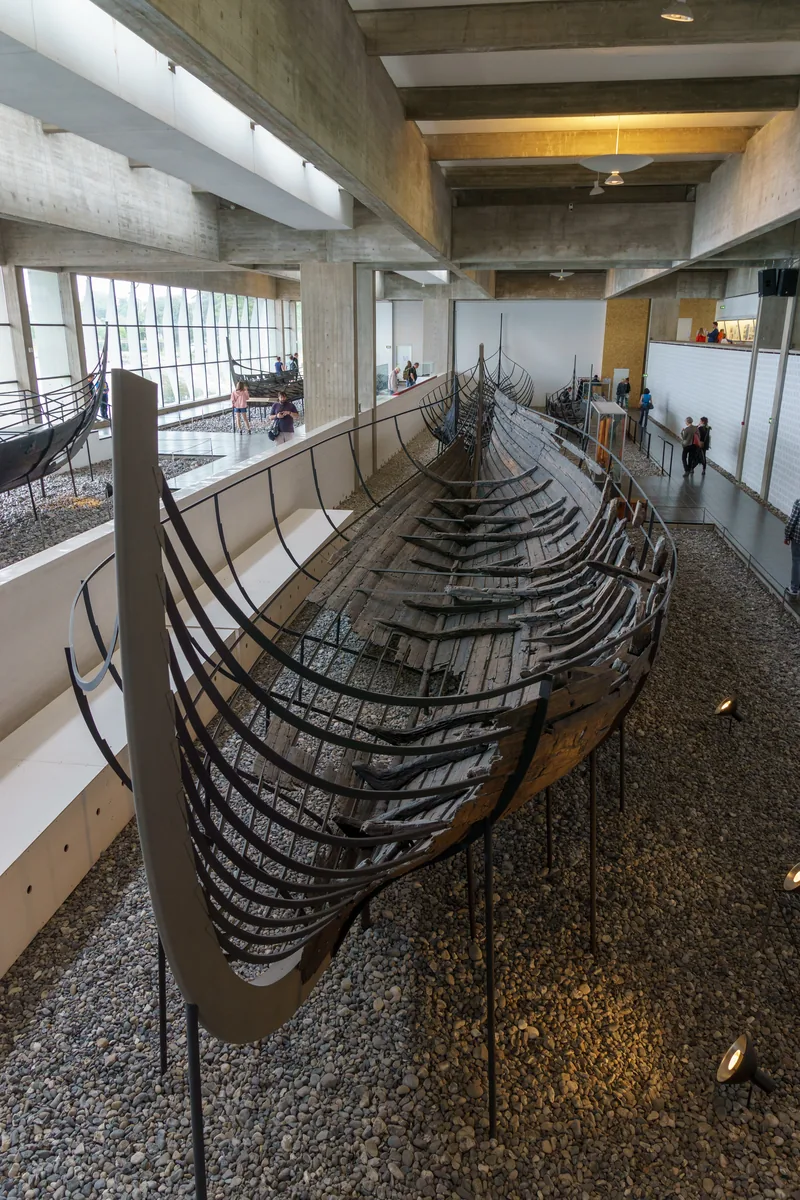
Skuldelev 1
A large ocean-going cargo ship from Sognefjord in western Norway, built of heavy pine planks, with a rounded form that the museum says gives it a high loading capacity and great seaworthiness on the North Atlantic. [source]
It is repeatedly repaired with oak near the Oslo Fjord and eastern Denmark. The museum’s English page for this ship does not give a length in a facts table, and this desk does not invent one. [source]
The great longship
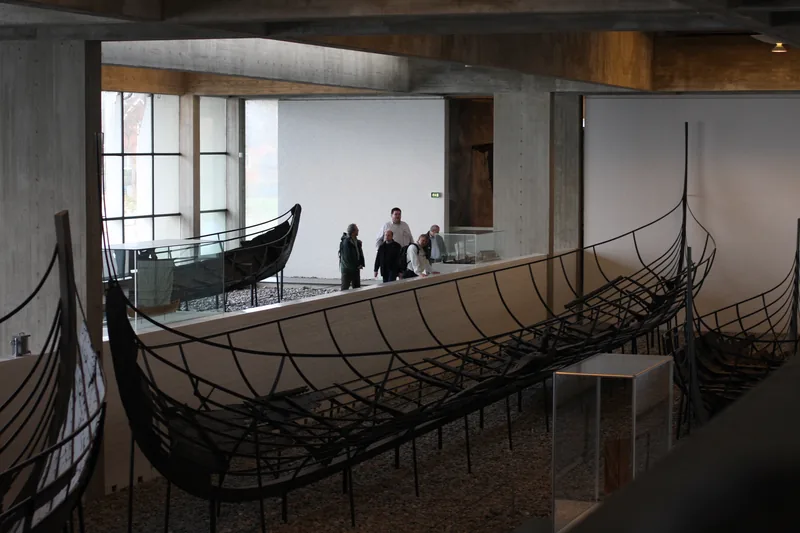
Skuldelev 2
A war machine, built to carry many warriors at high speed. With a crew of 65-70 men, it was a chieftain’s ship. The long, narrow shape and the enormous sail allowed great speed, and the manning of 60 oars made it possible to keep the ship moving even without wind. Those two official figures are not averaged here. [source]
Tree-ring analysis of the timber show that the ship was built of oak in the vicinity of Dublin around 1042. [source]
The coastal trader
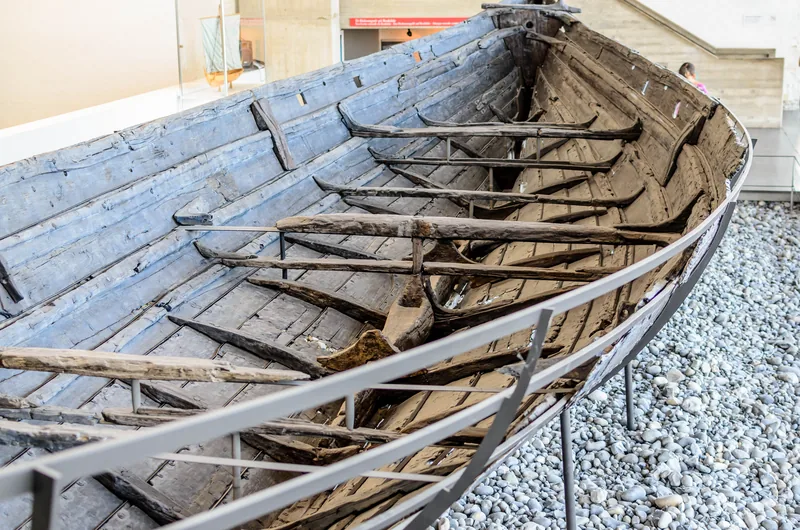
Skuldelev 3
A small, elegant and sturdy trading ship, built of Danish oak for Danish coastal waters and the Baltic, and the best preserved of the five. The prose on the same page gives room for about 4 tons of cargo; the facts table lists a cargo capacity of 4.6 tons. Both wordings stay on the desk. [source]
The small longship
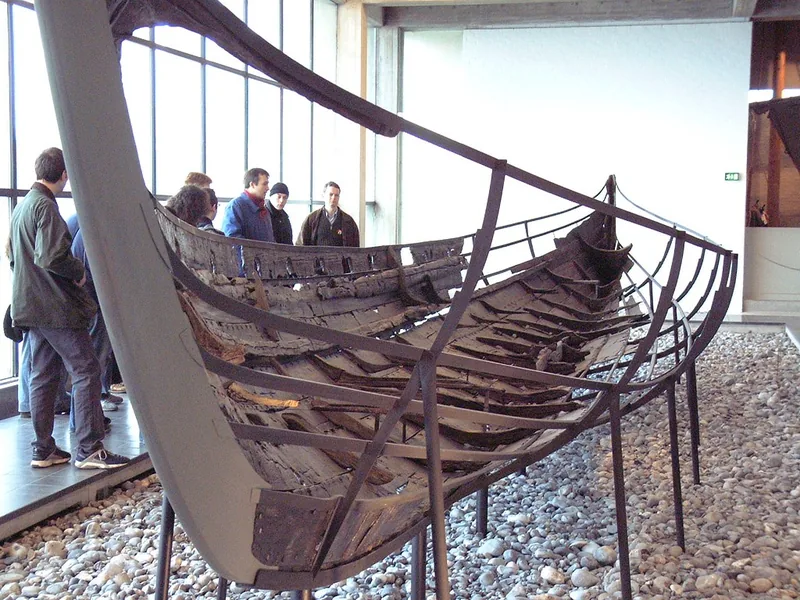
Skuldelev 5
One of the smallest long ship in a war fleet, in the museum’s English, ideal for Danish coastal waters and the short, choppy waves of the Baltic. Unlike the other Skuldelev ships, it is built using both new wood and recycled timber. The facts table gives 26 oars and a crew of ca. 30 men. [source]
The fishing vessel
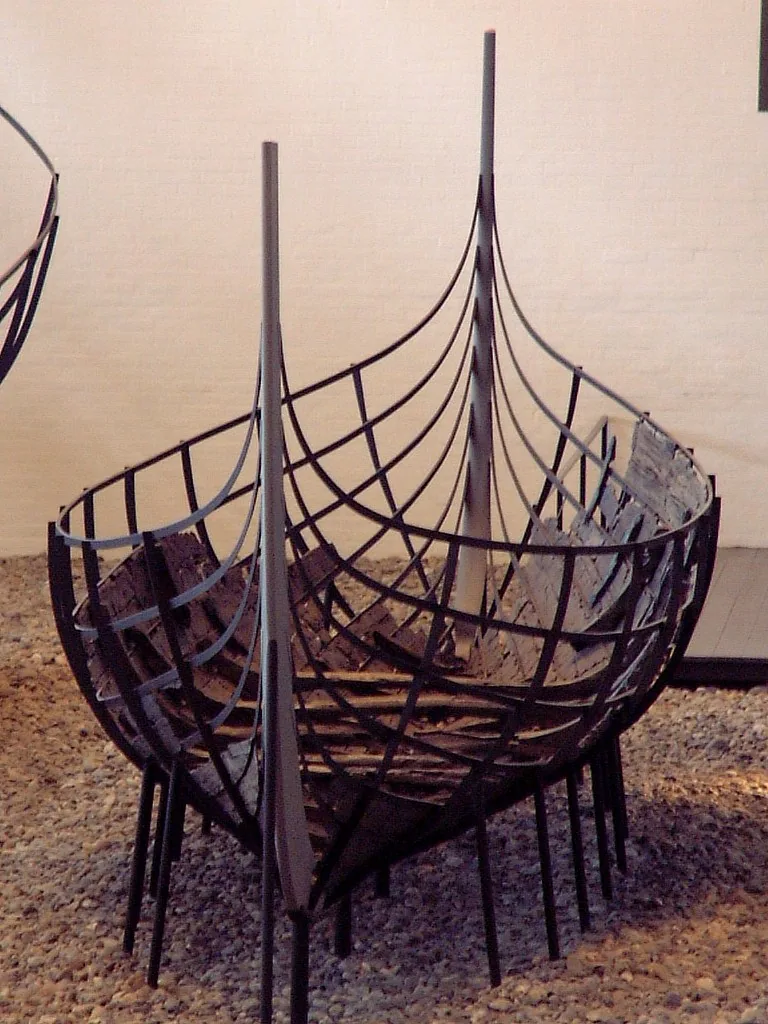
Skuldelev 6
A fishing boat, built in the Sognefjord area in western Norway, at the same time and place as the ocean-going trader Skuldelev 1. It is originally used for fishing in the deep Norwegian fjords, then increased with a plank in each side. [source]
Not a sixth wreck
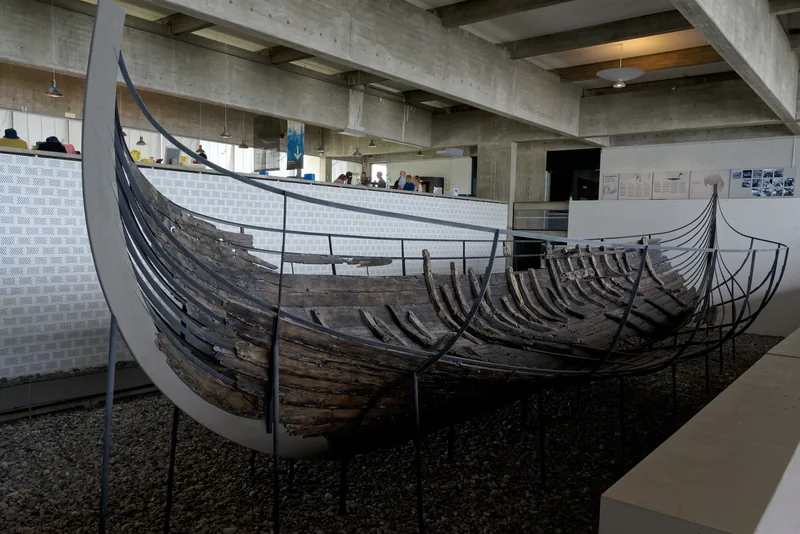
Ship number 4?
The excavation page’s map still includes the misinterpreted “ship number 4”. Parts which were classified as ship number 2 and ship number 4 actually were parts of the same ship, the Skuldelev 2-ship. Once that was clear, the barrier consisted of five ships. [source]
The ocean-going trader
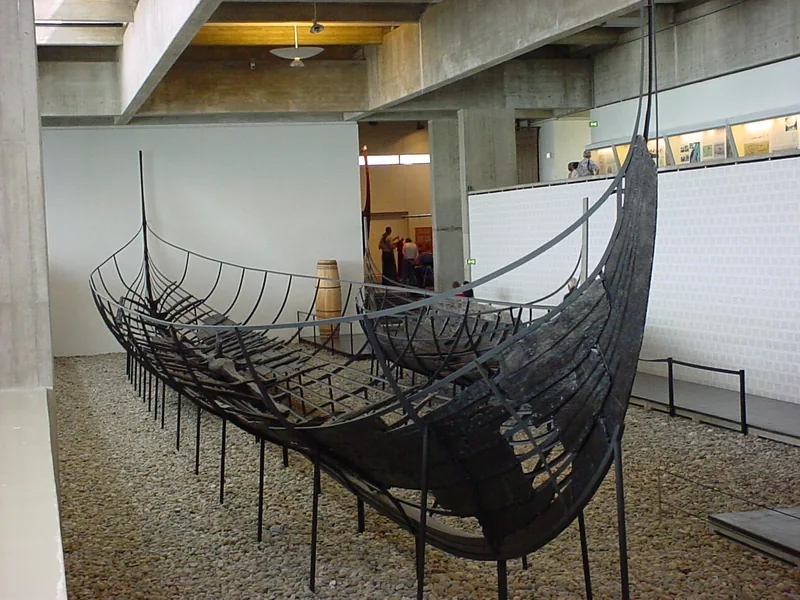
Skuldelev 1 is, the museum says, a large ocean-going cargo ship from Sognefjord in western Norway. It is built of heavy pine planks, and has a rounded form that gives it a high loading capacity and great seaworthiness on the North Atlantic. It is repeatedly repaired with oak near the Oslo Fjord and eastern Denmark. It could have sailed all over the North Sea and the Baltic as well as in the North Atlantic. The ship and its cargo may have been owned by a chieftain, or cooperatively by a group of merchants sailing it on “traditing expeditions” to the European markets — the museum’s word, left as written. It had decks fore and aft as well as an open hold amidships. [source]
The English page for Skuldelev 1 is a short one. It has no facts table, and it does not give a length, a breadth, or a cargo figure of the kind printed for Skuldelev 3, 5 and 6. This desk does not fill the gap from another book, or from the sailing copy Ottar. Ottar is the museum’s reconstruction, begun in 1999, and is on display in the Museum Harbour. [source] [source]
The Kraka Fyr collection page, talking about Skuldelev 6, says the original fishing boat was built in Sognefjord around 1030, “strangely enough, at the same time and place as the ocean-going Skuldelev 1 was being built.” They share a family feature: a longitudinal change in angle, the chine, along the bottom under the waterline. Skuldelev 1’s own English page does not itself give that date, so the “same time and place” is told here as the fishing-boat pages tell it. [source] [source]
The great longship
Skuldelev 2 is “a war machine, built to carry many warriors at high speed.” With a crew of 65-70 men, it was a chieftain’s ship, “like those praised in ancient scaldic verse and sagas.” Tree-ring analysis of the timber show that the ship was built of oak in the vicinity of Dublin around 1042. Vikings settled in Ireland in AD 800 and established several fortified bases along the Irish coast, which developed into towns. “Here Vikings lived as merchants, mercenary soldiers and shipbuilders.” [source]
Then come the two manning figures that should not be averaged. “The long, narrow shape of the ship and the enormous sail allowed at great speed.” And “the manning of 60 oars made it possible to keep the ship moving even without wind.” A crew of 65-70, and a manning of 60 oars, both official, both left standing. The English page, like the page for Skuldelev 1, does not print a length in a facts table, and this desk does not invent one. [source]
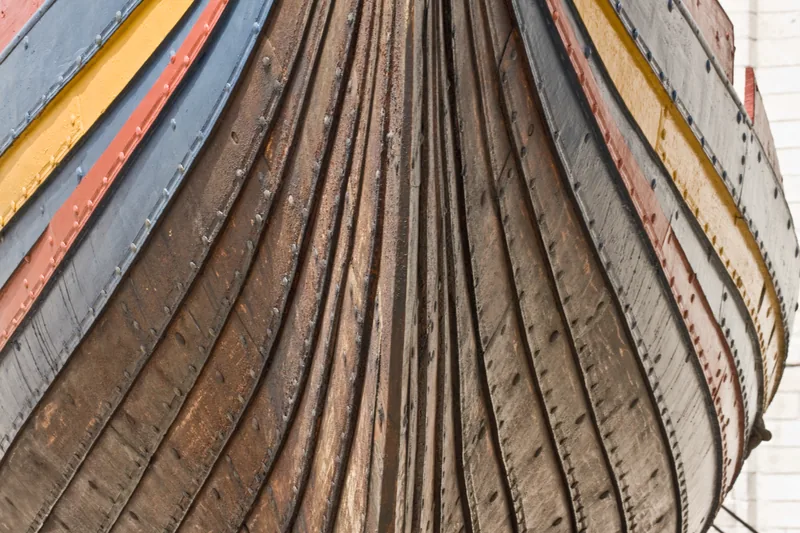
The sailing copy is The Sea Stallion from Glendalough, on display in the Museum Harbour. The reconstructions page describes the same war-machine wording, then adds figures that belong to that listing: a design “heavy and strong enough to carry its 112 m² sail, but also sufficiently light and long to be rowed by a crew of 60.” Those numbers are not moved quietly onto the wreck. [source] [source]
The coastal trader
Skuldelev 3 is “a small, elegant and sturdy trading ship, built for transporting goods in Danish coastal waters and the Baltic.” It is the best preserved of the five, and was built of Danish oak. It had decks of loose planks fore and aft and an open hold amidships “with room for about 4 tons of cargo.” The facts table on the same page lists a cargo capacity of 4.6 tons. About 4, and 4.6: both stay. [source]
The table dates the ship to ca. 1040, in Denmark, with about 75 % preserved, of oak. Length 14 metres, breadth 3.3 metres, draught 0.9 metres, displacement 9.6 tons, five oar ports, a crew of 5-8 men, a sail area of 45 m2, an average speed of 4-5 knots and a top speed of 8-10 knots. Wind was the most important means of powering the ship; the oars could be used when manoeuvring or when travelling short distances in calm weather. The ship may have been used when the owner and his associates or family “travelled to to a market or meetings at the assembly.” The repeated “to” is the museum’s, and is left as written. [source]
The small longship
Skuldelev 5 is “one of the smallest long ship in a war fleet,” in the museum’s English, “ideal for sailing in Danish coastal waters and through the short, choppy waves of the Baltic.” Unlike the other Skuldelev ships, it is built using both new wood and recycled timber, and a few years before it is sunk it is repaired with both new and recycled wood. The museum does not know why it was built this way, but says the construction and repairs were carried out by skilled boatbuilders. Along the sheerstrake there are fragments of the shield-rack, and on the 6th strake on the port side aft there are traces of a carved decoration. [source]
The facts table dates it to ca. 1030, in Denmark, with about 50 % preserved, of oak, pine, ash and alder. Length 17.3 metres, breadth 2.5 metres, draught 0.6 metres, displacement 7.8 tons, 26 oars, a crew of ca. 30 men, a sail area of 46 m2, an average speed of 6-7 knots and a top speed of ca. 15 knots. The Helge Ask collection page, describing the same original as a smaller warship, uses ca 1040. Both dates stay on the desk. [source] [source]
The fishing vessel
Skuldelev 6 is a fishing boat, built in the Sognefjord area in western Norway, at the same time and place as Skuldelev 1. “It is orginally used for fishing in the deep Norwegian fjords, but is then increased with a plank in each side.” During the alteration the original rowlocks were removed and the number of oars reduced. “The conversion presumably meant that the ship was used more for transport alng the Norwegian coast.” The spellings are the museum’s. [source]
The facts table dates it to ca. 1030, in Western Norway, with about 70 % preserved, of pine, birch, and oak. Length 11.2 metres, breadth 2.5 metres, draught 0.5 metres, displacement 3 tons, an original 14 oars, a crew of 5-15 men, a sail area of 26.5 m2, an average speed of 4-5 knots and a top speed of 9-12 knots. [source]
Enjoyed this desk on five ships, a barrier in a fjord, and a sixth wreck that was never a sixth wreck?
No pop-ups. No intrusive advertising. Just interesting stuff. A little support helps the next nautical.im site get built.