Home · The barrier
Peberrenden
The barrier in the fjord
Three worn-out ships, then two more after twenty years, filled with stones and sunk in the most direct route to Roskilde. The official story is a late-Viking-Age defence, not a date invented on this desk.
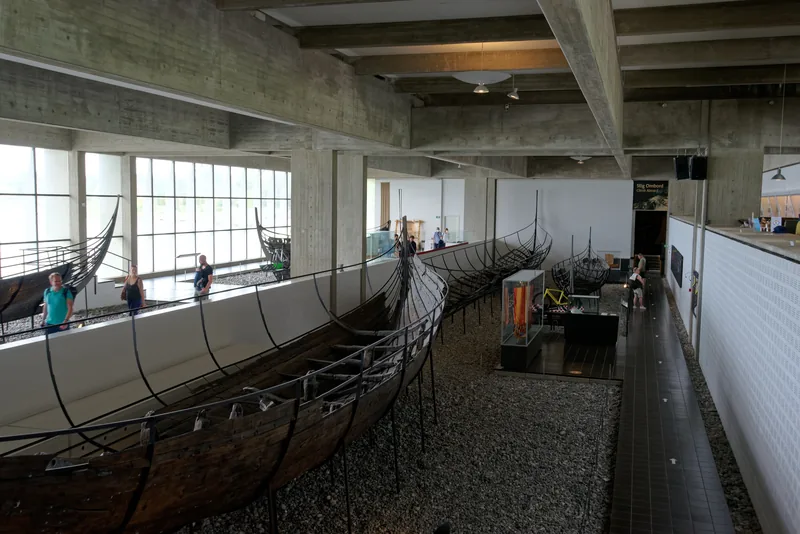
The five-ships page sets the scene without a calendar year. “During the late Viking Age, a system of barriers are established on Roskilde Fjord, making it possible to control the sea routes to one of Denmark’s great royal and ecclesiastical cities.” The grammar is rough, and it is official, so it stays. Three worn-out ships are towed out to the narrowest point, just outside the village of Skuldelev. “The ships are filled with stones and sunk in the sailing channel Peberrenden, which is the most direct route to Roskilde.” After twenty years, the barrier is reinforced with two more ships. “An effective defence system is created.” [source]
The excavation page names the two phases more closely. The first includes the Skuldelev 1-ship, the Skuldelev 3-ship, and the Skuldelev 5-ship; the second includes the Skuldelev 2-ship and the Skuldelev 6-ship. “The ships from the second phase, which layed on top of the barrier, were the ones most damaged by currents and ice-movement.” In particular, the largest ship in the barrier — the Skuldelev 2-ship — was poorly preserved, even with the addition of the section that had earlier been wrongly classified as ship number 4. [source]
After the sinking of the stone-laden ships, “a large number of posts” were added across the channel on the sailing route towards Roskilde. The barrier was not only five hulls of stone. It was ships and timber in a narrows, a way of deciding who could come up the fjord. [source]
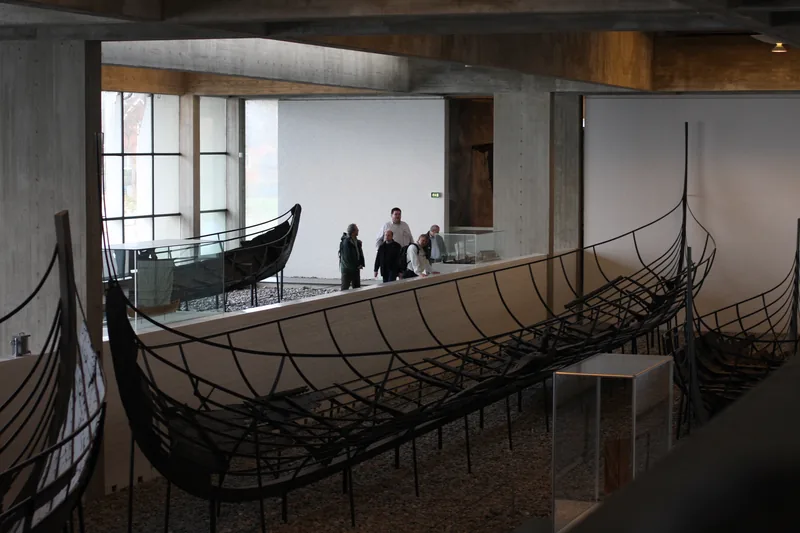
A date such as 1070 is sometimes attached to this story elsewhere. It does not appear on the museum English pages re-opened for this rebuild on 18 November 2026, and this site does not introduce it. What the five-ships page does say is “the late Viking Age,” and, a thousand years later, an iron cofferdam. The ship pages give their own datings for when the vessels were built: Skuldelev 2 around 1042 near Dublin, Skuldelev 3 ca. 1040, Skuldelev 5 ca. 1030 on the wreck table and ca 1040 on the Helge Ask page, Skuldelev 6 ca. 1030. Those are building dates, not the date the barrier was laid. [source] [source] [source] [source] [source] [source]
The second-phase ships, lying on top, took the weather. Currents and ice tore at them. At the bottom of Peberholmshullet, the 4-5 m-deep hole immediately to the west of the barrier, excavators later found “quite a large amount of ships’ timbers that had been torn away from the wrecks by the currents and ice.” Some were strake fragments, under a meter-thick layer of mud. The defence had done its work, and the fjord had done its work too. [source]
Skuldelev 5, unlike the others, was already a ship of new and recycled timber, repaired with both a few years before it was sunk. Skuldelev 6 had already been raised with an extra plank and sent more along the Norwegian coast. The ships that closed the channel were not new royal gifts. They were working boats and war boats that had had a life, and then a second job as a wall. [source] [source]
Enjoyed this desk on five ships, a barrier in a fjord, and a sixth wreck that was never a sixth wreck?
No pop-ups. No intrusive advertising. Just interesting stuff. A little support helps the next nautical.im site get built.