Home · The excavation
1962
Twelve weeks and one day
An iron cofferdam, pumps on 6 July, a photograph on 3 August, and five ships salvaged on 28 September. The sixth number on the map was part of the longship all along.
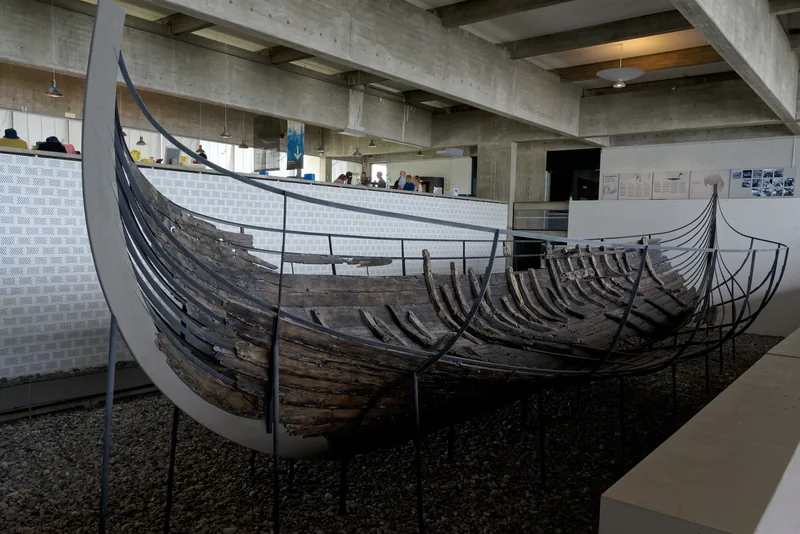
“60 years ago, one of the most groundbreaking archaeological excavations in Danish history began.” The excavation page still opens that way. After several years of preparations and minor diving investigations, the time had come to raise the newly found Viking ships from the bottom of Roskilde Fjord “so that they could be examined and preserved for posterity.” The challenges were enormous. The risk was high. “It was not at all certain it could be done.” [source]
The five-ships page compresses the same moment into a single image: “A thousand years later an iron cofferdam is driven into the seabed around the barrier. One of the most significant excavations in Denmark can begin.” [source]
On 5 July 1962, everything was ready. On 6 July the pumps were turned on, “to gradually remove the water from the dammed-up area where the ships lay.” The water in the cofferdam is “gradualy being lowered” — the museum’s spelling — to remove bottom vegetation, mud, stones, and whatever else might be covering the timbers. It might have seemed practical to drain the whole area at once and dig as if on land. The work instead went down in stages, about ten centimetres at a time, cleaning as the bottom was exposed, then lowering the water again. After a month, the water level had been reduced to 1.7 m below that of the water outside the cofferdam, and all of the five wrecks were partially exposed. [source]
At the beginning, “the ships emerged from the water as a large continuous ‘bridge’ over the channel.” The northern part of the Skuldelev 6-ship was very worn, but the ship had broken across Skuldelev 5, and quite a lot of it had survived, resting against the edge of the channel. [source]
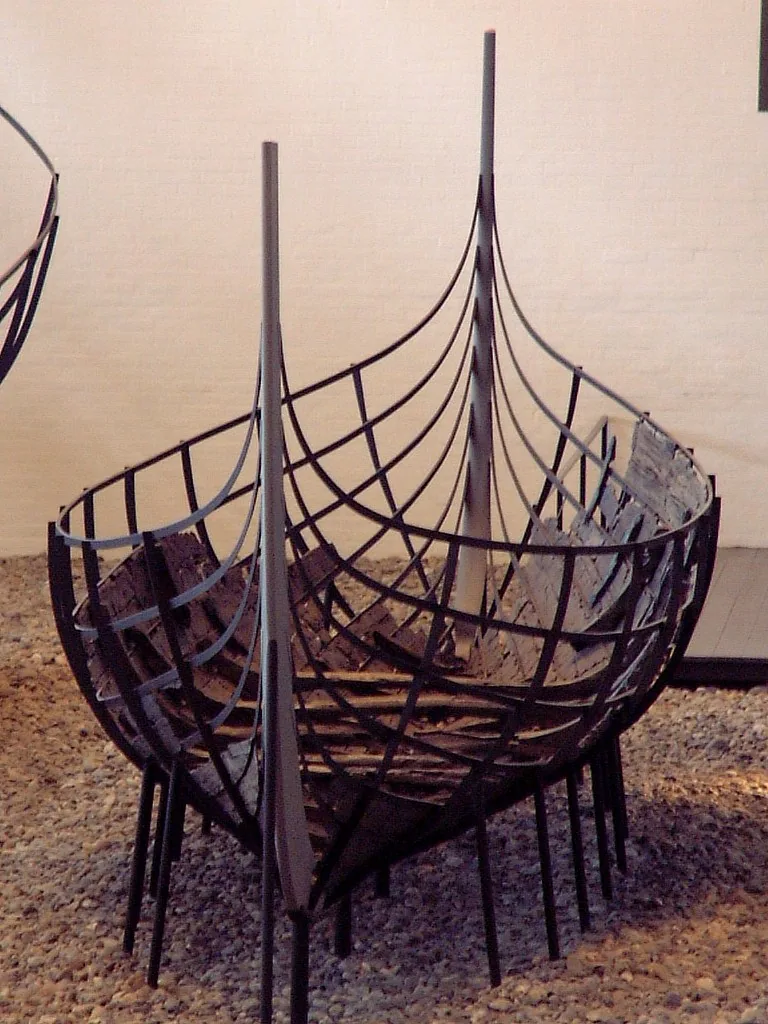
Ship number 4
The air photograph of the excavation area is dated 3 August 1962. The map at top left shows Skuldelev ships 1, 2, 3, 5 and 6, “including the misinterpreted ‘ship number 4’.” That is the official caption, still on the page. [source]
Later the same page explains what the number had been. “Parts, which were classified as ship number 2 and ship number 4, actually were parts of the same ship the Skuldelev 2-ship.” Once that was clear, “it was clear that the barrier consisted of five ships that back in the Viking Age had been filled with stones and sunken across the channel on the sailing route towards Roskilde.” The largest ship in the barrier was poorly preserved, “even with the addition of the section that had earlier been wrongly classified as ‘ship number 4’.” There were never six wrecks in the barrier. There were five ships, and a numbering that had to be taken back. [source]
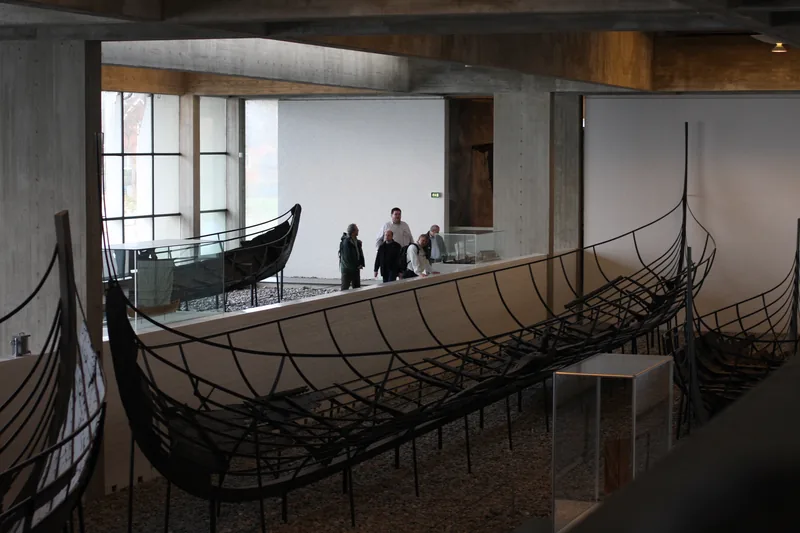
Salvage, bags, and a hole beside the barrier
It had been estimated from the outset that the excavation would take twelve weeks. “This turned out to be nearly correct. On 28 September — after twelve weeks and one day — all the five ships had been salvaged and the team of students could be sent home.” A boat service had brought visitors to the excavation area, where students described the current progress of the work. [source]
The work inside the cofferdam, however, was not yet finished. At the bottom of Peberholmshullet, the 4-5 m-deep hole immediately to the west of the barrier, there lay quite a large amount of ships’ timbers that had been torn away from the wrecks by the currents and ice. Some were strake fragments, under a meter-thick layer of mud. [source]
All the timber would have to be packed in airtight plastic bags “to prevent any drying during transport to the National Museum’s conservation workshop, where it was to be submerged in large water-filled tanks before the actual conservation.” Heavy-duty plastic bags in four widths between 25 and 55 cm had been purchased, sealed at both ends with electric welding nippers. “This process turned out to function very satisfactorily.” Unlike the pieces of other wood species, all the wreck parts of oak were relatively well preserved. “The centimeter-thin strakes had also retained their elasticity.” [source]
This site does not add an opening year for the hall, or a conservation timetable, that the re-opened English pages do not give. What they do give is the diary of a summer: pumps in July, a photograph in August, five ships up at the end of September, and a workshop waiting with tanks of water. [source]
Enjoyed this desk on five ships, a barrier in a fjord, and a sixth wreck that was never a sixth wreck?
No pop-ups. No intrusive advertising. Just interesting stuff. A little support helps the next nautical.im site get built.