Home · Reconstructions
The harbour
The sailing copies
Ottar, the Sea Stallion, Roar Ege and Estrid Byrding, Helge Ask, Kraka Fyr and Skjoldungen. Official building dates sometimes disagree, and reconstruction figures are not treated as wreck figures.
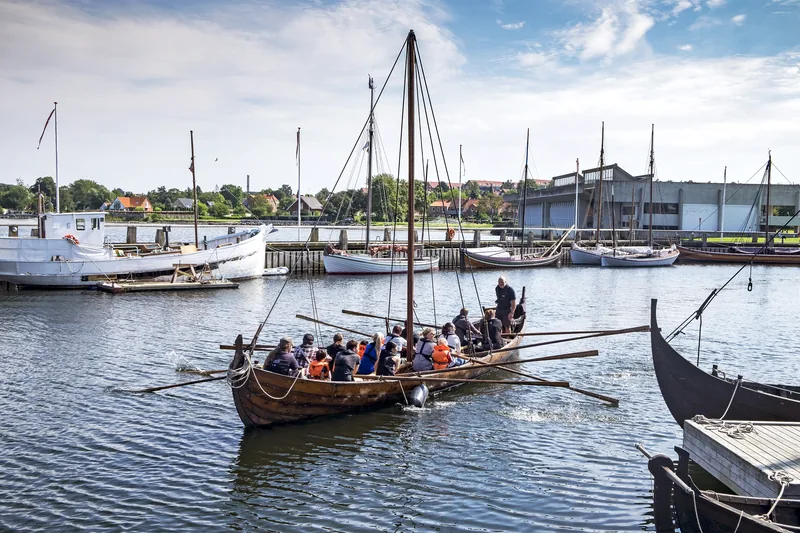
At the Viking Ship Museum’s shipyard, reconstructions of the five Viking ships excavated at Skuldelev in 1962 are being built. “Since Roar Ege, as the first reconstruction of the small merchant ship Skuldelev 3, was built in 1983, all 5 Skuldelev ships have been reconstructed. Some of them even two times.” The sailing reconstructions are located in “the Museums harbor during the summer season, side by side with the traditional wooden boats.” The harbour environment, the museum says, emphasizes the direct connection between the ships in the hall and their successors, and builds a bridge between history and tradition. [source]
The same page later says Skuldelev 3 “has been reconstructed two times — Roar Ege in 1982 and Estrid Byrding in 2017.” Built in 1983, and Roar Ege in 1982: both official lines, both left standing. [source]
This photograph of the harbour is not used to name a particular reconstruction. The boats sit side by side in summer; a single still is not a label. [source]
Ottar and the Sea Stallion
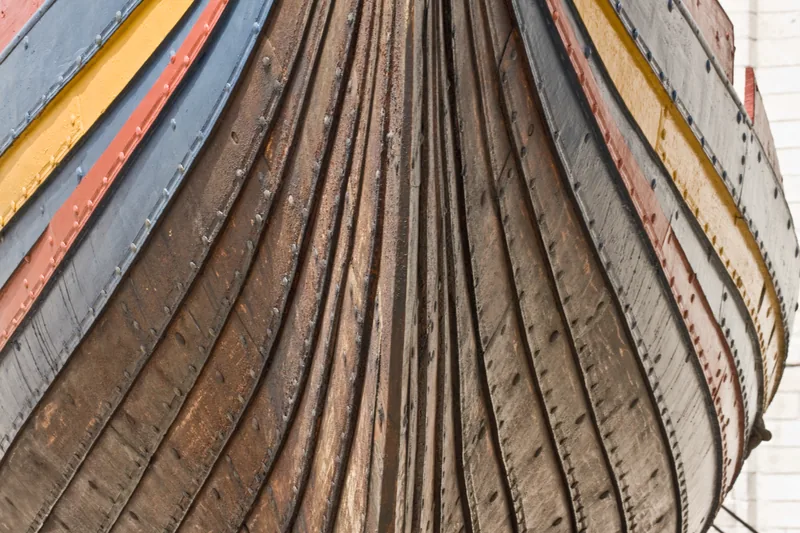
In 1999, the work on Ottar began, a reconstruction of the large ocean-going cargo ship from western Norway. “During the building process the boatbuilder found some unusual and unidentifiable axe marks on a biti.” Ottar is on display in the Museum Harbour. [source] [source]
The Sea Stallion from Glendalough is the reconstruction of Skuldelev 2. The reconstructions page calls it a war machine, “a bold design, both heavy and strong enough to carry its 112 m² sail, but also sufficiently light and long to be rowed by a crew of 60.” The wreck page gives a crew of 65-70 men and a manning of 60 oars. The 112 m² sail is told here as the reconstruction listing tells it, not as a facts-table figure for the original. [source] [source]
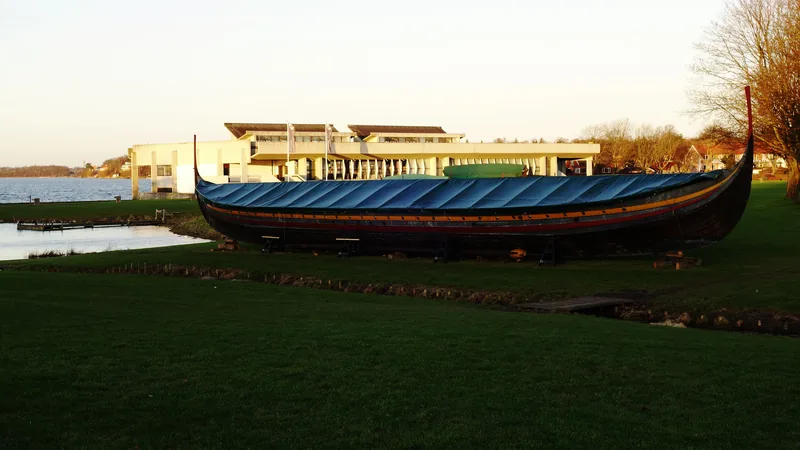
In winter the Sea Stallion has a lair. A ranking that appears on one Commons filename is not used on this site. What the museum does say is that the reconstructions are not definitive truths. “The represent suggestions on how the ships may have looked 1,000 years ago.” The grammar is official. For each new reconstruction they build and sail, they learn more “about the importance om ships in Viking Age society.” [source]
Helge Ask, and a ship of reused strakes
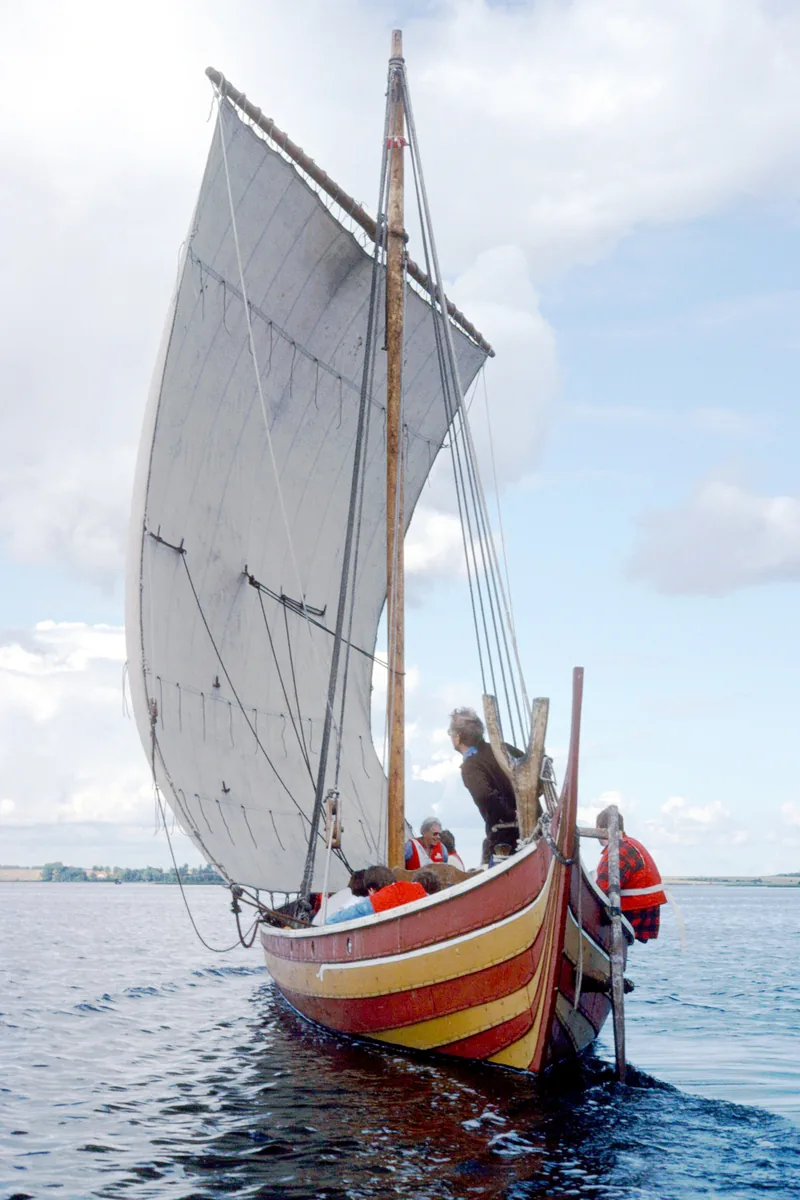
Helge Ask was built by the museum in 1990-91 of oak, pine and ash. It is a reconstruction of the small warship Skuldelev 5. The same collection page lists the year of construction as 1991. Both wordings stay. The ship was possibly a defensive vessel: “it not only formed part of the local defense force, but was also one of the smallest units in the Danish fleet of the period.” In medieval sagas and law texts, ships of this fleet were accounted for according to the number of thwarts they had, the smallest a “13-sesser”, the largest a “35-sesser”. A sesse is a thwart, the crosspiece on which a pair of oarsmen sit, and Skuldelev 5 carried 26 oars — it was a “13-sesser”. [source]
Of the original ship, about 65% has been preserved. The bottom and almost all of the port side were intact, which made it relatively easy to reconstruct the missing starboard side. The reconstructions page gives the same idea as “approximately 65 %.” [source] [source]
The unusual characteristic of this warship, the Helge Ask page says, is that at some stage in its life the top strakes were damaged and replaced with those from another ship. Square oarholes in the “new” top strake did not harmonise with the oar positions of Skuldelev 5. As can be seen in the wreck in the hall, “these were blanked off with wooden plates and new, round oarholes at the correct intervals were bored.” Helge Ask was reconstructed as Skuldelev 5 originally appeared. [source] [source]
As the first Viking Ship Museum reconstruction, Helge Ask is decorated with colour and carving. When it is put to sea on special, festive occasions, a dragon head is secured to the prow and a tail to the stern, “even though a warship of this modest size would hardly have flourished such a big-ship embellishment.” Shields similar to the ones the ship must have carried originally are placed along the sides. “It has not been possible to discover traces of paint on the Skuldelev ships,” but there exist many indications, archaeological and in written records. [source]
The collection page also lists reconstruction measurements: length 17.30 meter, width 2.70 meter, depth/draft 0.50 meter, weight 2.00 tons, displacement 5,5 tons, 26 oars, a crew of approx 30 men, a sail area of 46 m2, an estimated maximum speed under sail of approx 15 knots and under oars of 5,5 knots. The wreck facts table gives length 17.3 metres, breadth 2.5 metres, draught 0.6 metres, displacement 7.8 tons, and a top speed of ca. 15 knots. Those two sets of figures are not merged. [source] [source]
Kraka Fyr, Skjoldungen, and a boat like an eggshell
In 1998, the museum’s boatbuilders reconstructed Skuldelev 6, the fishing boat from western Norway. “Skuldelev 6 has reconstructed 2 times, first i 1998 and in 2010.” The two copies are Kraka Fyr and Skjoldungen, on display at the museum harbour. [source] [source]
Kraka Fyr was built of pine, birch and oak in the boatyard in 1998. The original, the collection page says, was built in Sognefjord around 1030, “strangely enough, at the same time and place as the ocean-going Skuldelev 1 was being built.” They share the chine under the waterline. Skuldelev 6 was originally a relatively low-boarded fishing boat with six strakes, and could be rowed from no less than 14 oar positions along the gunwale — a decided advantage, because fishing gear or catches often blocked access to several rowlocks. The hull is “virtually self-supporting — almost like an eggshell.” One disadvantage is that the crew had to insert loose thwarts to sit on and row. [source]
Later, it is not known precisely when, the fishing boat was converted into a cargo carrier by removing the rowlocks and adding a seventh strake, presumably of the type the Vikings called a “byrding”, “a boat that carries something.” At the moment Kraka Fyr is a reconstruction of Skuldelev 6 in its original shape as a fishing boat, “although it is possible that in the future an attempt will be made to convert it into a ‘byrding’ in the same way as its predecessor.” [source]
Suggestions, not definitive truths
The boatbuilders work with copies of Viking Age tools and corresponding materials and techniques. “The shape of the hull is reconstructed based on the preserved parts of the original ship. The missing parts are reconstructed using other ship-finds, Viking Age ship motifs and more modern traditional Nordic clinker-built boats, which hark back to the Viking Age ship design. The process is called experimental archaeology.” [source]
Today the museum has more than 50 different vessels, and many of them were built at the boatyard. From 1 May to 30 September, visitors can get on board “one of the descendants of the Viking ships, a Nordic wooden boat, and sail out on Roskilde Fjord.” That invitation is for a descendant in the harbour, not for the wrecks in the hall. [source]
Enjoyed this desk on five ships, a barrier in a fjord, and a sixth wreck that was never a sixth wreck?
No pop-ups. No intrusive advertising. Just interesting stuff. A little support helps the next nautical.im site get built.